Part IVSeptember 2020
Kashmir and Ladakh · 4 of 10
Dining at the High Table
The Early Military History of Kashmir
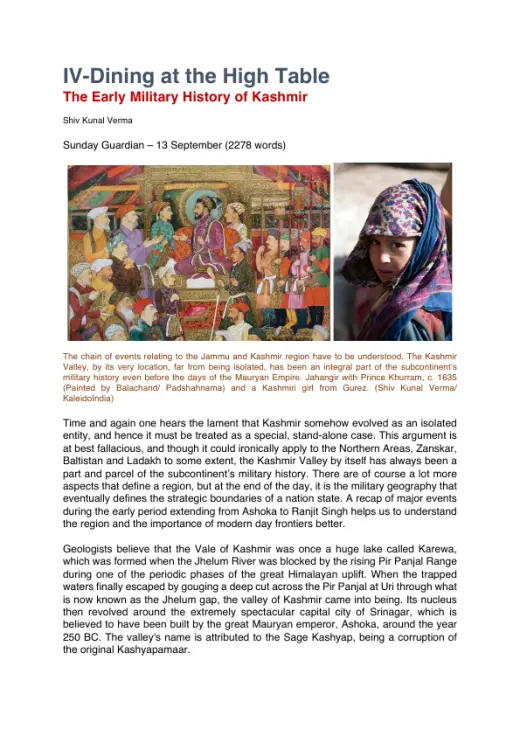
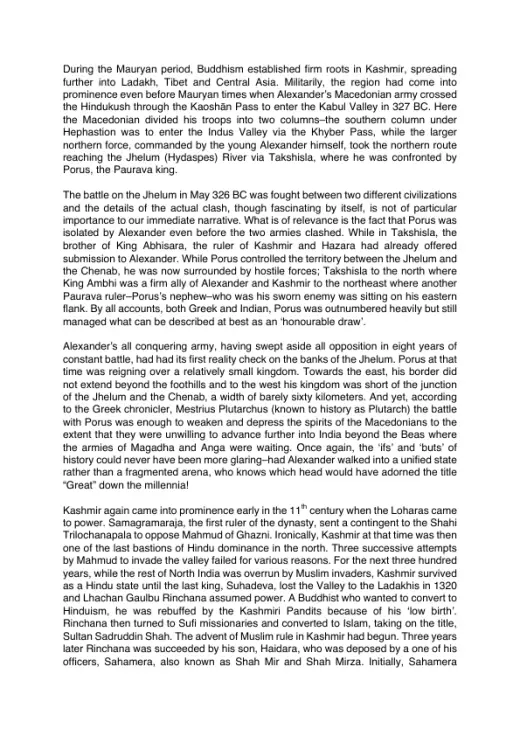
Time and again one hears the lament that Kashmir somehow evolved as an isolated entity, and hence it must be treated as a special, stand-alone case. This argument is at best fallacious, and though it could ironically apply to the Northern Areas, Zanskar, Baltistan and Ladakh to some extent, the Kashmir Valley by itself has always been a part and parcel of the subcontinent’s military history. There are of course a lot more aspects that define a region, but at the end of the day, it is the military geography that eventually defines the strategic boundaries of a nation state. A recap of major events during the early period extending from Ashoka to Ranjit Singh helps us to understand the region and the importance of modern day frontiers better.
Geologists believe that the Vale of Kashmir was once a huge lake called Karewa, which was formed when the Jhelum River was blocked by the rising Pir Panjal Range during one of the periodic phases of the great Himalayan uplift. When the trapped waters finally escaped by gouging a deep cut across the Pir Panjal at Uri through what is now known as the Jhelum gap, the valley of Kashmir came into being. Its nucleus then revolved around the extremely spectacular capital city of Srinagar, which is believed to have been built by the great Mauryan emperor, Ashoka, around the year 250 BC. The valley's name is attributed to the Sage Kashyap, being a corruption of the original Kashyapamaar.
During the Mauryan period, Buddhism established firm roots in Kashmir, spreading further into Ladakh, Tibet and Central Asia. Militarily, the region had come into prominence even before Mauryan times when Alexander’s Macedonian army crossed the Hindukush through the Kaoshān Pass to enter the Kabul Valley in 327 BC. Here the Macedonian divided his troops into two columns–the southern column under Hephastion was to enter the Indus Valley via the Khyber Pass, while the larger northern force, commanded by the young Alexander himself, took the northern route reaching the Jhelum (Hydaspes) River via Takshisla, where he was confronted by Porus, the Paurava king.
The battle on the Jhelum in May 326 BC was fought between two different civilizations and the details of the actual clash, though fascinating by itself, is not of particular importance to our immediate narrative. What is of relevance is the fact that Porus was isolated by Alexander even before the two armies clashed. While in Takshisla, the brother of King Abhisara, the ruler of Kashmir and Hazara had already offered submission to Alexander. While Porus controlled the territory between the Jhelum and the Chenab, he was now surrounded by hostile forces; Takshisla to the north where King Ambhi was a firm ally of Alexander and Kashmir to the northeast where another Paurava ruler–Porus’s nephew–who was his sworn enemy was sitting on his eastern flank. By all accounts, both Greek and Indian, Porus was outnumbered heavily but still managed what can be described at best as an ‘honourable draw’.
Alexander’s all conquering army, having swept aside all opposition in eight years of constant battle, had had its first reality check on the banks of the Jhelum. Porus at that time was reigning over a relatively small kingdom. Towards the east, his border did not extend beyond the foothills and to the west his kingdom was short of the junction of the Jhelum and the Chenab, a width of barely sixty kilometers. And yet, according to the Greek chronicler, Mestrius Plutarchus (known to history as Plutarch) the battle with Porus was enough to weaken and depress the spirits of the Macedonians to the extent that they were unwilling to advance further into India beyond the Beas where the armies of Magadha and Anga were waiting. Once again, the ‘ifs’ and ‘buts’ of history could never have been more glaring–had Alexander walked into a unified state rather than a fragmented arena, who knows which head would have adorned the title “Great” down the millennia!
Kashmir again came into prominence early in the 11th century when the Loharas came to power. Samagramaraja, the first ruler of the dynasty, sent a contingent to the Shahi Trilochanapala to oppose Mahmud of Ghazni. Ironically, Kashmir at that time was then one of the last bastions of Hindu dominance in the north. Three successive attempts by Mahmud to invade the valley failed for various reasons. For the next three hundred years, while the rest of North India was overrun by Muslim invaders, Kashmir survived as a Hindu state until the last king, Suhadeva, lost the Valley to the Ladakhis in 1320 and Lhachan Gaulbu Rinchana assumed power. A Buddhist who wanted to convert to Hinduism, he was rebuffed by the Kashmiri Pandits because of his ‘low birth’. Rinchana then turned to Sufi missionaries and converted to Islam, taking on the title, Sultan Sadruddin Shah. The advent of Muslim rule in Kashmir had begun. Three years later Rinchana was succeeded by his son, Haidara, who was deposed by a one of his officers, Sahamera, also known as Shah Mir and Shah Mirza. Initially, Sahamera placed Udyanadeva, a relative of Suhadeva on the throne, but in 1339, Sahamera seized power and had himself crowned as Shams-ud-din.
In May 1398, as the Chagatai Turks with Timur at the helm swept into northern India, they crossed the Jhelum close to where Porus had fought Alexander. Historians believe that in less than a year, Timur inflicted upon India more misery than had ever before been inflicted by any conqueror in a single invasion. Having let loose the Army of Islam which defeated the Delhi Sultanate, Timur backtracked to Kabul and Samarkand, killing as many Hindus as his army could lay hands on. The Kashmir Valley, fortunately by then under Muslim rule, escaped Timur’s fury, but the same cannot be said for the Raja of Jammu, who was forcibly converted and his subjects murdered en masse.
While Timur was running amuck in the rest of North India, Shams-ud-din’s successors had more or less established a firm foot hold on the Valley. Sikander came to the throne in 1389 as an infant when Qutb-ud-din died. He subsequently removed all signs of Hinduism and Buddhism from the Valley. According to Firishta, he issued orders proscribing the residence of any person other than a follower of Islam in the Valley. Many Brahmins, rather than abandon their religion or their country, chose to commit suicide while immigration of Muslim immigrants was welcomed with open arms. After the reign of Sikander, his son Ali Shah kept up the anti-Hindu and anti-Buddhist stance.
In 1420, Ali Shah was most probably killed while fighting against the Khokars, and his brother, Shahi Khan, was crowned with the title Zain-ul-Abidin. In a reign that lasted half a century, he was perhaps the greatest Muslim monarch to have ruled over Kashmir. He made a sincere effort to undo the injustice done to the Hindus by his two tyrannical predecessors. During his reign, the Kashmir Sultanate reached its geographical zenith, his empire and influence extending over Gandhara, Sindhu, Madra and Rajapuri. To the north and west, Ladakh, most of Tibet and the country on either side of the Indus River came under his control. Zain-ul-Abidin allied himself with the Khokhar chief, Jasrath, who in turn brought the entire Punjab under his control. Even as the Mughals swept into India in the early 16th Century, Babur had his eyes on Kashmir, but an expedition sent by him met with no success. Both Babur and Humayun were too busy fighting other battles to turn their full attention on Kashmir, but Akbar coveted the state for its climate and environment. After a cat and mouse game that started in 1578, when the then ruler, Ali Shah agreed to strike coins and read the khutba in Akbar’s name, the Mughal emperor finally succeeded in capturing Kashmir only in October 1586 when an expedition under Qasim Khan forced Yakub Khan into exile in Kishtwar. Akbar himself visited Srinagar six years later, when he turned Kashmir into a reserved territory (khalisa).
Akbar introduced an elaborate system of village level revenue during his reign and also built the Hariparbat Fort as a famine relief measure. His son, Jahangir, laid out the famous Shalimar and Nishat gardens and introduced the Chinar tree from Iran. In 1620, the territory under Mughal rule was further extended to the south with the capture of Kishtwar. Jahangir in turn was succeeded by Shah Jehan in 1627, who was then followed by Aurangzeb in 1658, the last Mughal emperor who had any impact on Kashmir.
Next in the chronology of events, Nadir Shah's invasion of the seat of Mughal power at Delhi in 1738 had weakened their imperial hold on Kashmir. With the decline of Mughal power in India, the governors of Kashmir became irresponsible and cruel. In 1762, in alliance with the Dogra ruler of Jammu, Raja Ranjit Dev, the Afghans annexed Kashmir. When the Afghan leader, Ahmed Shah Durrani died in 1772, Jawan Sher, the Afghan ruler of Kashmir, set himself up as an independent ruler. Afghan domination lasted for little more than half a century, the period generally being remembered as one of the darkest and most brutal periods of Kashmir's history. The Sikh Confederacy had come into being in 1716; basically a collection of small to medium sized political Sikh states called misls. The Sikhs had first established themselves as a political power in the Punjab in 1765, when Jassa Singh Ahluwalia captured the territory annexed by Ahmed Shah Durrani but they were a fragmented lot whose mode of fighting, somewhat like the Rajputs of Rajasthan, was desultory and hardly suited to the requirements of a well-settled state. From amidst the ashes, as it were, the saga of Maharaja Ranjit Singh then emerged. He was not only one of the most important characters in the history of the Sikhs, but also in the history of Northern India.
By 1799, after a series of battles with the Afghans who controlled most of West Punjab and Gujarat, Ranjit Singh had siezed and occupied Lahore. This was a great physiological blow to the Afghans who were beginning to look more and more vulnerable in front of the young Sikh, whose own stature was growing by the day. Having tasted the smell of victory and power, the expansionist in the twenty-year old came to the fore and he turned his attention towards Jammu. The Maharaja of Jammu had no intention of taking on Ranjit Singh and presented him with a nazrana of 20,000 rupees. He then again swung westwards and marched towards Sialkot and Dilawargarh, accepting nazranas in both these places as well.
For the British, keeping the rampaging Ranjit Singh confined to the north and west of the Sutlej was of paramount importance. Charles Metcalfe, the acting Governor General of India, was leaning on Ranjit Singh who in turn was procrastinating, trying every trick in the book to circumvent British designs. While he distrusted the British, the Sikh Maharaja also knew the limits of his own military strength and eventually on April 25, 1809, the Treaty of Amritsar was signed with the East India Company wherein the broad line of demarcation was the Sutlej River. This arrangement was to preserve the peace with the British for the next forty years; more importantly, it also left Ranjit Singh free to expand his empire to the north and to the west–the freedom which he was to exploit to the hilt and in the process, change the very face of India during the next two decades.
Ranjit Singh spent the following years gradually pushing the Gurkhas out of the Kangra region and the Afghans out of Western Punjab back across the Indus into the hills eventually capturing Pashtun territory including the city of Peshawar. Historically, this spelt the end of Muslim domination of over a thousand years over India’s western gateway; stemming the tide of the Afghan marauders who had until then periodically poured into Northern India from the Khyber pass to commit arson, pillage and slaughter across the eastern plains of India. This was also the first time that Pashtuns were ruled by non-Muslims.
Interestingly, the majority of Ranjit Singh’s subjects were Muslims, the numbers swelling with each conquest as Multan, Kashmir and finally Peshawar came under his control. The northern and western borders of modern India were beginning to take shape, though Independent India was still more than a century away. The British, who had emerged as the key players by then, were quite content to play the waiting game in the Punjab, and they in turn were busy trimming areas of Gurkha influence, gradually pushing them back from the Shivaliks and the Himalayan foothills into the geographical limits of Nepal. By 1818, the only parts of India beyond British control were a fringe of Himalayan states to the north and Ranjit Singh’s kingdom which covered the Indus Valley and Kashmir which lay to the north. Sind, though independent, was under British protection while to the south Ceylon had already been occupied by the British. To the east lay the valley and hill tracts of Assam and the Buddhist kingdom of Myanmar (Burma) straddling the Irrawaddy River. In 1819 Kashmir was formally annexed when a Sikh military force literally walked into the Valley, not only ending five centuries of Muslim rule but more importantly, bringing the sprawling Himalayan region into the political Indian equation by wresting it from Afghanistan. This one act of Ranjit Singh clearly defined the borders with Afghanistan and by annexing Kashmir, the geographical entity of the subcontinent was now more or a less a compact whole.
Shiv Kunal Verma is the author of the highly acclaimed 1962: The War That Wasn’t and The Long Road to Siachen: The Question Why.
A reply, printed with Part IV
The Nay Sayers
Historical evidence is our DNA
By Shonaleeka Kaul · The Sunday Guardian, 13 September 2020 · 1,399 words
In his perceptive piece on Kashmir published on Sept 6, aptly titled ‘The Pied Pipers of Hate’, Shiv Kunal Verma made a quiet plea for at least two kinds of realization: one, the unity of India over and above the narrow domestic walls that divide Indians in the micro perspective. And two, the deeply corrupt political reality of the Kashmir problem, which is sought instead to be placed at India’s doorstep, specifically in her alleged ‘occupation’ of a land that people have been indoctrinated to believe was never a part of India. Verma rightly states that 73 years into the founding of the modern Indian nation-state, it is high time and only natural that these realisations were internalized. Instead, however, what is on view is a sustained stoking of the embers that keep India burning.
He may be guilty of being idealistic in his expectations, given the internal and international vested interests that he calls out, and given also a larger conspiracy of silence and suppression over some aspects of the history of India and Kashmir in particular. Nonetheless, it bears stating that, though Verma invokes military geography, longue durèe history too would endorse his contentions.
Thus, though the British left an enduring legacy of telling us otherwise, it is clear that there are astonishing convergences over the centuries in the way a disparate set of historical commentators and observers attest a readily recognizable idea of India. And Kashmir is always there in it! This idea embraces, with no apparent unease, both India’s vastness and spatial unity as well as her incredible diversity. This will sound familiar to those conversant with the claims of India’s nationalist movement leading up to 1947 and after; however it is not the invention of that movement. Sample just a few of the premodern historical testimonies.
Perhaps the earliest text to define India, ‘Bharatavarsha’, broadly yet resonantly, as the land between Himalayas and the sea, and to include the people of Kashmir, among others, within it is the hoary Mahabharata (5th century BCE to 5th century CE). Next, in the 4th century BCE, the Greek ambassador to India, Megasthenes also described the land of the people of ‘Indoi’ as bounded by the sea to the east, west and south, Mt. Hemodos (Abode of Snow) to the north where it was separated from central Asia, and the Indus to the west.
Interestingly, Ptolemy, the celebrated 2nd century geographer from the Roman Empire based in Egypt, not only spoke of an India that went east of the mouth of the river Ganga right up till China, but cited the Hindukush as its western boundary. This would resonate with Xuan Zang, the Chinese traveller’s testimony in the 7th century. Zang, standing at ancient Nagarahara (modern Jalalabad, Afghanistan), west of the Khyber Pass, felt he stood at the gateway to the country called ‘Indu’. He described Indu, again, in classical terms as bounded by the snowy mountains to the north and the sea on three sides, extending to an area of 9o,ooo li (Chinese mile) and inhabited by 70 different kingdoms.
The Vishnu Purana meanwhile in the 5th century CE was saying the following: ‘The country north of the sea and south of the Himalayas Is Bharata and her children are Bharati.
A thousand yojanas from north to south, It has kiratas in the east and yavanas in the west’ (VP 2. 3, verses 1, 8)
Kiratas refer to denizens of Assam and the eastern Himalayas while yavanas to those settled in Greater Punjab. Can there be a more explicit and inclusive self-understanding of India?
This is seen again in the 6th century encyclopaedia Brhat Samhita which exhaustively enumerates the many regions and peoples that were part of India. This list mentions, among others, Kashmir and Peshawar in the north up to Dravidas, Kerala and Karnataka down south, while Assam, Odisha and Bengal bring up the east and Saurashtra the west. The sheer clarity and detail of this idea of India as a unity through her plurality is mind boggling, coming as it does from more than 1500 years ago. One can give more examples, such as the 11th century Arab traveller Al biruni’s similar understanding of ‘Hind’, or the 14th century Indo-Persian poet Amir Khusrau’s citing of Hind’s diverse languages (hindawi) which, apart from Sanskrit, included Kashmiri, Punjabi, Bengali, Gujarati, Kannada and Tamil, etc. Or the 16th century famed Mughal historian Abul Fazl who wrote: “The sea borders Hindustan on the east, west and south. In the north, the great mountain ranges separate India from Turan, Iran and China … Intelligent men of the past have considered Kabul and Qandahar as the twin gates of Hindustan… By guarding these, Hindustan obtains peace.”
The Tibetans on the other hand called India rGya-gar (Vast Land?) or Phags-Yul (Noble Country) and their famous works, like Lama Taranath’s 16th century History of Buddhism in India, mention their Buddhist masters coming from Phags-Yul belonging to Kashmir and Peshawar (N), Andhra and Kanchi (S), Saurashtra (W) and Bengal (E).
Again and again then not only does India, by whatever name they called her, emerge over the centuries as a unity in the testimony of disparate residents and outsiders alike, that too of different faiths; but Kashmir figures prominently in all these conceptions of the Indic. Nor is this surprising if you look closely at cultural markers diagnostic of Kashmiri regional identity for 2000 formative years, starting, again, as early as the 5th century BCE.
In my book I have expanded on the ‘connected histories’ approach to properly understand Kashmir’s origins. Suffice it here to summarise that be it Kashmir’s early material culture, her art, scripts (Brahmi and her descendent Sharada) and languages (Sanskrit, Prakrit and their cognate Indo-Aryan tongue Kashmiri) or her literature, philosophy and faiths (Buddhism, Shaktism, Shaivism, Vaishnavism): there is visible a geo-cultural synchronicity between Kashmir and large parts of the rest of the Indian subcontinent across this vast stretch of time. She was intensively and mutually involved with not only her neighbouring regions like Himachal and Punjab but with centres deep within the interiors of India like Patna, Nalanda, Gaya, Banaras, Allahabad, Mathura, Malwa, Saurashtra, Bengal till Karnataka, Kerala and Tamil Nadu.
Kashmiris for over two millennia looked to these places for politics, trade, education, asylum, employment, art, religion, philosophy, fashion (!), and pilgrimage. And people from other parts of India are seen in the historical sources visiting or migrating to Kashmir over centuries for the same reasons.
For example, Kashmir seems to have been a part of pan-Indian political formations from the very beginning, namely, the Mauryan empire c. 4th century BCE. And it was Emperor Asoka Maurya from Magadha (Bihar) who is said to have founded Srinagar as well as brought Buddhism to the Valley, which Kashmiris then took all over China and central Asia. On a different plane, Kannada couture and coin-types were adopted in the Kashmiri court of King Harsha in the 11th century CE. What an open and cosmopolitan culture! Alongside, works of Kashmiri Sanskrit scholars, especially on poetics, circulated extensively in South India as learned models. An author has recently well captured this cultural infusion by the phrase ‘saffron in the rasam’! How did all this happen if Kashmir was never a part of India?
Indeed, Kashmir was clearly not only Indic in her genesis and composition, she also came to master and pioneer elements of Indic culture and thought for at least 1500 years and is recognized for it by contemporaries. This alone explains one of the most potent ancient symbols of both India’s historical unity and Kashmir’s place in it, namely, the pan-Indic voyages of Shankacharya, the 8th century seer-intellectual who established the supremacy of advaita or trans-sectarian monist consciousness. Starting from his home town of Kaladi, Kerala, Shankara undertook three famous digvijayas -- tours of philosophical conquest of the land, intensely debating the varied local scholarship across the length and breadth of this country. The fitting culmination of these advaitic travels was each time reserved for Kashmir at the seat of all learning (sarvagyapith), the Sharadapith (today lying derelict in PoK), which Shankara was able to ascend through his intellectual prowess. Indeed, the ancient Shankaracharya temple at Srinagar still stands witness to this epic visit as also to the incredible centrality of the far north of India to the imagination of its far south, and vice versa. Need one say more?
Shonaleeka Kaul is Associate Professor, Centre for Historical Studies, Jawaharlal Nehru University and the author of The Making of Early Kashmir: Landscape and identity in the Rajatarangini (Oxford University Press, 2018)
Original PDF